Burnout builds through patterns most people miss. These 8 apps help you spot the signs early, protect your energy, and track your way back to balance in 2026.

Founder at Anticipate
Published:
Workplace burnout costs the global economy $1 trillion annually in lost productivity, according to the World Health Organization. Nearly half of all employees worldwide report feeling chronically burned out, and the trend is accelerating.
The right tools surface exhaustion patterns before they become a crisis and track whether recovery interventions are actually working. The wrong approach is waiting until you can’t function.
This guide compares the best apps for burnout recovery, prevention, and resilience tracking — features, pros/cons, pricing, and who each is really built for — so you can find the right fit for where you are.
| Anticipate App | Welltory | BurnoutGuard | |
|---|---|---|---|
| Best for | Best app for burnout recovery, prevention, and resilience tracking in one place | Biometric stress and body recovery measurement | Dedicated burnout risk scoring and forecasting |
| How it detects burnout | Sensor-fusion: mood, sleep, activity, medication | Heart rate variability (HRV) analysis | Stress, energy, workload, screen time |
| Therapy and clinical support | Therapy notes and talking points for clinicians | Wellness reports for reference | PDF reports for consultations |
| Privacy | On-device, no sign-up, no ads | GDPR-compliant, encrypted | User-owned, exportable |
Note: Burnout is a recognized occupational phenomenon (WHO, ICD-11). If exhaustion, cynicism, or reduced effectiveness is affecting your daily life, relationships, or health, professional support from a licensed clinician is the most effective path to recovery. These apps complement professional care.
We evaluated burnout-related apps across four categories:
We prioritized apps that are actively maintained, transparent about how they work, and useful as complements to professional care. Burnout is a clinical concern, and no app replaces a therapist, psychiatrist, or organizational change. But the right digital tools can help you see what’s happening, take action sooner, and track whether interventions are working.
Features, pricing, and platform availability at a glance.
| App | Best For | Focus | Cost | Platform |
| Anticipate App | Best app for burnout recovery, prevention, and resilience tracking in one place | AI mood prediction, exhaustion patterns | Free forever or $3.99/mo | iOS |
| Welltory | Biometric stress and body recovery measurement | HRV-based stress and energy | $99/yr | iOS, Android |
| BurnoutGuard | Dedicated burnout risk scoring and forecasting | AI burnout risk assessment | $4.99/mo or $39.99/yr | iOS |
| Sunsama | Mindful daily planning that prevents overwork | Workload management, shutdown rituals | $22/mo | Web, iOS, Android |
| Headspace | Guided meditation and stress reduction for burnout prevention | Mindfulness and stress management | $12.99/mo or $69.99/yr | iOS, Android |
| 6th Mind | Free burnout recovery program | Audio-visual entrainment therapy | Free | iOS, Android |
| Reclaim AI | Smart work scheduling that protects focus and prevents overload | AI calendar optimization | Free or $10/user/mo | Web, Google Calendar, Outlook |
| Ahead | Emotional intelligence coaching and resilience building | EQ coaching, stress response training | $9.99/mo or $59.99/yr | iOS, Android |
Below is a detailed overview of each app — what it does best, key features, cons, and pricing — so you can find the right fit for your situation.
Best for: Best app for burnout recovery, prevention, and resilience tracking in one place
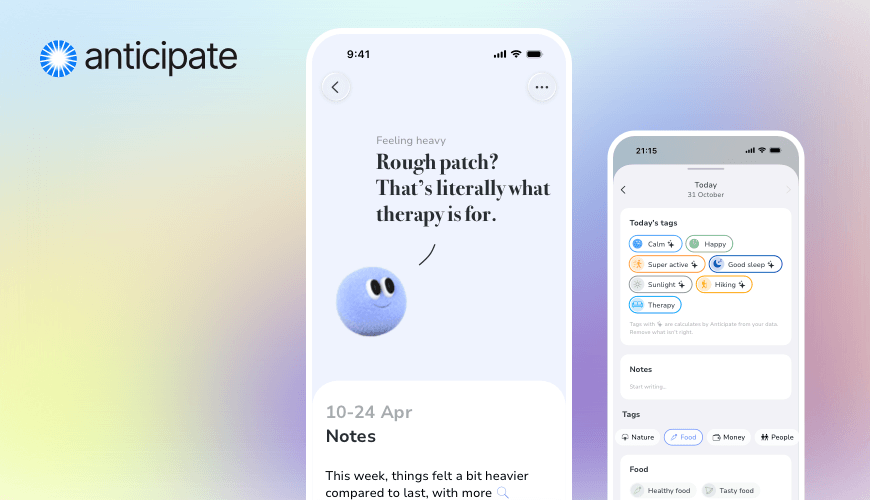
Burnout doesn’t announce itself. It builds quietly through weeks of declining mood, disrupted sleep, reduced activity, and withdrawal from routines. By the time most people recognize it, they’re already deep in it.
Anticipate App catches these patterns early. Using a sensor-fusion model, it passively blends data from Apple Health (sleep duration, sleep quality, physical activity, exercise), environment (weather, travel, daylight hours), habits (meditation, sunlight exposure), and your own mood entries to create a real-time picture of how you’re trending. You don’t need to manually log anything for core tracking to work. The app watches for the warning signs: a mood that’s been drifting downward, nights getting shorter, activity dropping off, routines breaking apart.
For people already experiencing burnout, Anticipate becomes a recovery tracker. If you’re adjusting medication, starting therapy, or making lifestyle changes, the app shows whether those interventions are working. It generates therapy preparation notes and talking points from your tracked data, so every session with a clinician starts informed. Instead of trying to remember how the last two weeks felt, you walk in with patterns, correlations, and a clear picture of what’s improving and what isn’t.
Most burnout apps focus on prevention or stress management. Anticipate is different because it tracks recovery. When you’re coming back from burnout, the question isn’t just ‘am I less stressed?’ but ‘is my sleep normalizing? Is my activity returning? Is my mood stabilizing?’
Anticipate answers these questions with data, not feelings. The therapy preparation feature is especially valuable during recovery: people in burnout often struggle to articulate what’s wrong. Anticipate turns weeks of passive data into clear talking points that help clinicians understand the full picture.
Best for: Biometric stress measurement and body recovery tracking
Welltory adds an objective layer to burnout tracking by measuring heart rate variability (HRV) and also works with 100+ biomarkers. While mood trackers rely on how you think you feel, HRV shows how your autonomic nervous system is actually responding to stress. A consistently low HRV is one of the earliest physiological indicators of chronic stress and burnout.
The app integrates with wearables and health apps to pull in sleep, activity, and productivity data, then correlates it with stress measurements. Daily readiness scores tell you whether your body has recovered from yesterday’s demands or whether you’re running on fumes. For data-driven people, this biometric feedback loop can catch burnout patterns that subjective mood logging misses.
Best for: Dedicated burnout risk scoring and forecasting
BurnoutGuard is one of the few apps purpose-built for burnout detection. It’s a simple tool to analyze your stress levels, energy, workload, and screen time, then generates a burnout risk score from 0 to 100. The score updates as your patterns change, giving you a clear, ongoing measure of where you stand.
Premium features include burnout forecasting that predicts where you’re heading based on current trends, Apple Health integration for automatic sleep data import, and PDF wellness reports formatted for healthcare consultations.
Best for: Mindful daily planning that prevents overwork
Sunsama is a mix of a task manager, calendar, and daily planner built for people who want to actually get meaningful work done without feeling overwhelmed. The idea is pretty simple — help you stay focused on high-impact tasks while cutting down on distractions, so you don’t end the day burned out.
It works across desktop and mobile (with the mobile app more as a companion), and everything ties back to the web app. What’s nice is that every morning it walks you through a short planning routine — you review your tasks, figure out what actually matters today, and then map that onto your calendar. From there, it helps you block time for work, stay focused by muting distractions, and realistically plan your day so you’re not overloading yourself or feeling guilty about what didn’t get done.
At the end of each day, a shutdown ritual prompts you to reflect on what you accomplished, move unfinished tasks, and mentally close the workday. This daily bookending builds sustainable work habits instead of the ‘always on’ cycle that leads to burnout. The app integrates with Asana, Jira, Linear, Notion, Slack, Gmail, Outlook, and more.
Best for: Guided meditation and stress reduction for burnout prevention
Headspace was our top pick as a meditation solution within the mental health category. But beyond that, a lot of people use it more broadly as a way to manage stress and deal with the day-to-day pressure that builds up over time.
For many, that stress is closely tied to work and burnout. That’s where something like Headspace can actually make a real difference. It helps people step back, slow down, and build simple habits around meditation and mindfulness that reduce stress over time. For those already feeling burned out or heading in that direction — consistent meditation is one of the more practical, non-clinical ways to regain some balance and feel more in control again.
Structured multi-week courses make it easy to build a habit from scratch. SOS sessions provide immediate help during acute stress moments. Sleepcasts and sleep-specific content address the sleep disruption that both causes and results from burnout.
Best for: Free burnout recovery program
6th Mind is a burnout recovery app built around Audio-Visual Entrainment (AVE) therapy. It’s based on real therapy data, drawing from over 500+ therapy sessions.
It’s not meant to replace traditional treatment, but rather complement it alongside therapy or medication. The experience starts with an initial assessment, and from there users get a personalized 15-day recovery protocol, followed by AI-optimized sessions as they continue.
Sessions are 20-30 minutes and recommended daily, preferably in the evening. Most users report initial improvements in energy and mood within 2-3 weeks. Full recovery from severe burnout typically takes 8-12 weeks of consistent use. The entire program is completely free.
Best for: Smart work scheduling that protects focus and prevents overload
Reclaim AI (now part of Dropbox after being acquired in 2024) is designed to help professionals maintain focus and manage their time more effectively. It automatically schedules tasks, habits, meetings, and breaks around priorities, helping ensure that time is used more intentionally and that focus isn’t constantly disrupted. The overall approach is about bringing more structure and clarity to the workday and prevent burnout.
Users report saving an average of 7.6 hours per week through smarter scheduling, which is why it made it onto our list of burnout-related tools. While it doesn’t address mental health directly, it helps improve visibility into workload and creates a more balanced schedule. For professionals who feel overwhelmed by constant meetings or shifting priorities, it can be a practical way to bring more stability into the day.
Best for: Emotional intelligence coaching and resilience building
Ahead calls itself the ‘Duolingo of emotional intelligence.’ You choose what to work on (keeping calm under pressure, coping with anxiety, building confidence) and the app delivers a personalized coaching plan with daily 5-minute sessions. For burnout recovery, the focus on emotional regulation and resilience is directly relevant.
Companies implementing Ahead report a 32% reduction in burnout symptoms among regular users. The bite-sized format works for people who are already exhausted and can’t commit to 30-minute meditation sessions. Each session builds practical emotional management skills you can use in real time.
The World Health Organization classifies burnout as an occupational phenomenon in ICD-11, characterized by chronic workplace stress that has not been successfully managed. It manifests as energy depletion or exhaustion, increased mental distance or negativity toward one’s job, and reduced professional effectiveness.
Research supports multiple intervention approaches. A 2022 meta-analysis in JAMA Network Open found that individual-directed interventions (mindfulness, CBT, stress management) can reduce burnout symptoms, though organizational-level changes have larger and more sustained effects (Awa et al., 2022). A 2020 systematic review in the International Journal of Environmental Research and Public Health confirmed that smartphone-based interventions can effectively reduce perceived stress and improve well-being in working populations (Linardon, 2020).
Heart rate variability (HRV) has emerged as a reliable biomarker for chronic stress. A 2018 study in Frontiers in Public Health found that reduced HRV correlates with emotional exhaustion and depersonalization, two core dimensions of burnout (Luque-Casado et al., 2018). Apps that track HRV provide an objective measure that complements subjective mood and energy assessments.
However, no app can replace organizational change or professional clinical support. The most effective burnout interventions combine individual coping strategies with structural improvements in workload, autonomy, and workplace culture.
Burnout apps can help you detect patterns, manage daily stress, and track recovery. But burnout is fundamentally an occupational and systemic issue. If your workplace demands consistently exceed your capacity, no app will fix that.
If exhaustion, cynicism, or reduced effectiveness is affecting your health, relationships, or ability to function, professional support provides the most effective path to recovery. Apps like Anticipate App are designed to complement that process, helping you and your clinician track what’s working and what needs to change.
1. World Health Organization (2019). Burn-out an 'occupational phenomenon': International Classification of Diseases (ICD-11). WHO News Item.
2. Firth, J., Torous, J., Nicholas, J., et al. (2017). The efficacy of smartphone-based mental health interventions for depressive symptoms: A meta-analysis of randomized controlled trials. World Psychiatry, 16(3), 287-298.
3. Torous, J., Nicholas, J., Larsen, M. E., Firth, J., & Christensen, H. (2018). Clinical review of user engagement with mental health smartphone apps. Evidence-Based Mental Health, 21(3), 116-119.
4. National Institute of Mental Health. Technology and the Future of Mental Health Treatment.

Download Anticipate and let passive tracking show you the patterns behind your exhaustion, so you can take action before burnout takes over.
No ads, full on-device privacy.

Scan to download

Scan to download
